Fabric and care
What is on the label, and why
Three pieces of information are required on clothing sold in the United States: what it is made of, how to clean it, and where it was made. We publish all three on every product page rather than on a sewn-in label you only see after the box arrives. This page explains how to read them, and adds two disclosures the law does not require but that office clothing badly needs: opacity, and honest easy-care language.
Fibre content
The Textile Fiber Products Identification Act requires every fibre present at 5% or more to be named by its generic name, with its percentage by weight, listed in descending order. That is exactly how the composition block is written on every product page: 97% Cotton, 3% Elastane, not “cotton blend”.
Generic names matter because trade names hide behaviour. Lyocell and viscose are both made from wood pulp and behave very differently in a wash; naming them generically lets you compare. Where a fibre is present under 5% and has no functional purpose it is declared as “other fibres”; where it does have a purpose — the elastane in a stretch trouser — it is named and its percentage given, whatever the number.
A piece whose composition does not total 100%, or is not in descending order, does not appear on this storefront at all. That is enforced in the code that builds these pages, not by review.
Care instructions
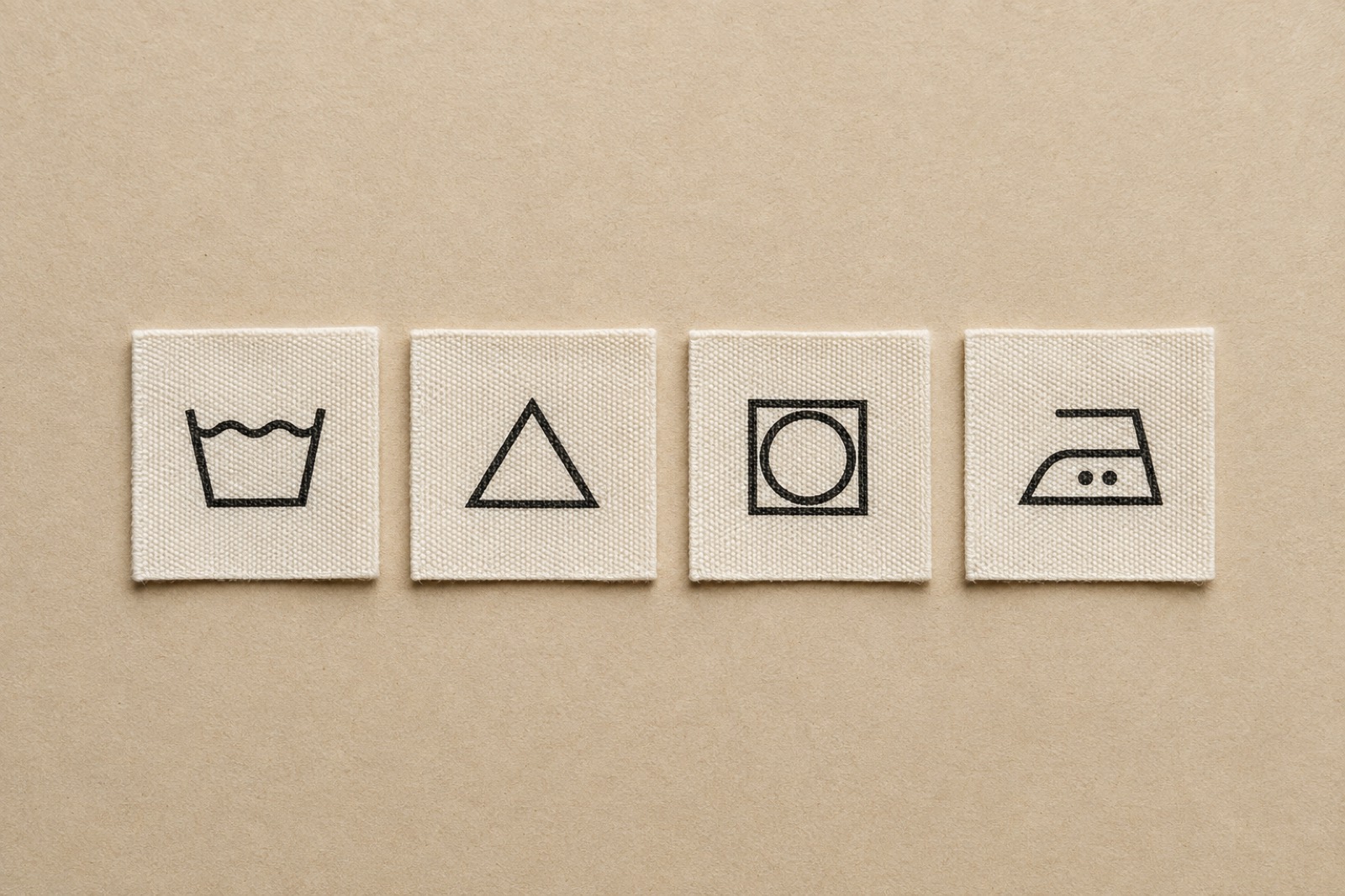
The FTC Care Labeling Rule, 16 CFR Part 423, requires at least one safe cleaning method with warnings for anything that would harm the garment. Every piece here carries four lines rather than a symbol: wash, bleach, dry, iron, each with a temperature or a limit in both Celsius and Fahrenheit.
Where a care instruction says “do not”, it is because we tested it and it damaged the cloth — not as a precaution to shift risk onto you. Where a method is safe but slower, we say which one is safer rather than only listing the fastest.
Country of origin
19 U.S.C. §1304 requires imported goods to be marked with their country of origin. Every product page names the country the piece was made in. Across the current range those countries are: Bangladesh, China, India, Italy, Portugal, Türkiye, Vietnam.
We make no domestic-origin claim for any piece. Such a claim carries a very high substantiation standard — effectively all or virtually all of the product and its components must be of domestic origin — and we do not currently have piece-by-piece evidence to that standard for anything we sell. Rather than use a softer phrasing that implies the same thing, we say nothing at all beyond the country named on the page.
Wool and shrinkage
The Wool Products Labeling Act requires wool to be identified by type — new wool, recycled wool — with its percentage. 7 pieces in the range contain wool, and each of them carries the wool type, the percentage, whether it can be machine washed, and a specific shrinkage warning with a number in it.
That number is the part usually missing elsewhere. “May shrink” tells you nothing. A merino crew washed above 30°C can felt and lose up to 5% of its length, and that is not reversible: no amount of blocking brings it back. If a piece is dry clean only we say so and explain what home washing would do to it.
We do not sell real fur, and no piece in the range contains it.
- Merino Crew Sweater — 100% New wool (merino), machine washable on a wool cycle
- Merino V-Neck — 100% New wool (merino), machine washable on a wool cycle
- Fine-Gauge Cardigan — 80% New wool, not machine washable
- Sleeveless Knit Vest — 55% New wool, not machine washable
- Unstructured Blazer — 54% New wool, not machine washable
- Structured Blazer — 100% New wool, not machine washable
- Overshirt Wool-Blend — 60% New wool, not machine washable
Opacity, and how we test it
Nothing in United States law requires a clothing seller to tell you whether you can see through a garment. For pale office clothing it is the single most common complaint, and it is entirely avoidable, so we treat it as mandatory.
Every piece is graded on three levels:
- Opaque — light does not pass through in normal indoor or daylight conditions.
- Semi-sheer — under direct overhead light the outline of what is worn beneath is visible. Plan a layer.
- Sheer — you can see through the cloth. Intentional, and not meant to be worn as a single layer.
The test is the same every time: the piece is laid flat against a lightbox at a fixed distance under a fixed brightness, and photographed. That photograph is published on the product page next to the flat shot, so the grade is not just our word for it. Pale cards — SL-02 Oat White and SL-05 Camel — cannot be listed at all without an opacity field, which is enforced in code.
Where a garment is opaque only because of its lining, we say that too. The Sleeveless Column Dress is a good example: the shell alone is semi-sheer and the finished dress is opaque, and both facts are on its page.
5 pieces in the current range are graded something other than opaque:
- Silk-Blend Blouse — semi-sheer
- Tencel Drape Blouse — semi-sheer
- Fine-Gauge Cardigan — semi-sheer
- Scarf Silk-Blend Square — sheer
- Five-Day Starter (Warm) — semi-sheer
What we will not claim
Some phrases are effectively standard in clothing copy and are not true of any woven cloth. We have banned them from this site, and the ban is enforced at build time: if any of these strings appears anywhere in the source, the site fails to build and does not deploy.
- Absolute fabric performance — a cloth that never creases, never needs pressing, or cannot stain. Where a finish genuinely reduces creasing we call it easy-care and state exactly what pressing is still required. The Easy-Care Twill Shirt says two to three minutes on the collar, cuffs and placket, because that is what it takes.
- Body and figure claims — that a garment slims, flatters a figure, hides part of you, or fits everyone. These are not measurable, and the published size chart contradicts the last one directly.
- Domestic-origin claims we cannot substantiate piece by piece, as set out above.
- Health or medical claims. Clothing is clothing. Nothing here improves posture or relieves anything.
The same list also blocks placeholder copy and the name of any payment provider, so nothing unfinished and nothing that belongs in our back office can reach a customer.
California Proposition 65
California's Safe Drinking Water and Toxic Enforcement Act requires a warning before knowingly exposing anyone in California to a listed substance above the safe harbour level. In clothing this is almost always about trims rather than cloth: zips, buckles, buttons, rivets and some coatings.
Every trim in this range has been assessed against the listed substances, and the assessment result is published on each product page. Where a warning is required it appears on the product page and on the packaging; where it is not, we say that explicitly rather than leaving the section blank. No piece in the current range requires a Proposition 65 warning.